
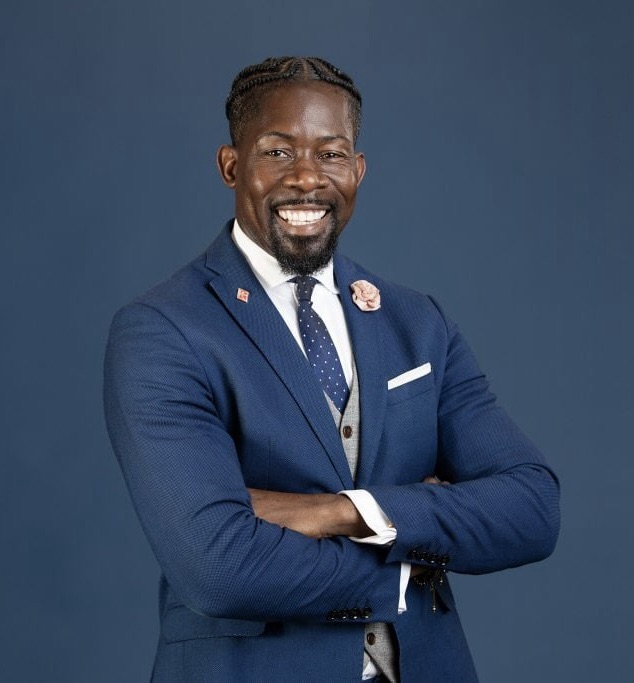
The Des Moines community has been rocked in recent days. Dr. Ian Roberts—former superintendent of Des Moines Public Schools, respected educator, and Olympic athlete—was detained and arrested by ICE. His arrest was sudden, shocking, and filled with contradictions. For many, it wasn’t just about one man—it was about what it means to be Black in Iowa, about safety, dignity, and belonging.
On episode two of Podcast Cousins, I sat down with Lya Williams of Black Iowa News, Daron “360” Richardson of Brothers Gon’ Work it Out, and Corey Dion Lewis of The Healthy Project Podcast—to circle the wagon, process what happened, and name the truths we live with every day.
“This is bigger than just one man.”
When news first broke, reactions were immediate and raw.
“I couldn’t imagine getting in my car on a Friday and not knowing I’m not going to come back home,” Lya shared, reflecting on what Dr. Roberts’ detention symbolizes for Black Iowans.
Corey added, “If you strip away everything, this was just a dude trying to do great in our community. And he was just attacked for what I feel like are bigger reasons that we just don’t know yet.”
For Daron, the news wasn’t a surprise—it was confirmation. “It came as no surprise based on the assumptions I had made about this administration and what they were willing to do to make political hay.”
The Smear Campaign and Media Spin
Almost immediately, the narrative became tangled in headlines and speculation. ICE released photos of the arrest, and allegations surfaced about weapons, cash, and “fleeing.” But the community wasn’t convinced.
“My journalistic tendencies are starting to tingle,” I admitted during our conversation. “Why are you releasing photos of a pending investigation? My immediate thought was—this is the start of a smear campaign. They want this man to be a criminal.”
Lya echoed that skepticism: “It’s disingenuous—who rules and policies attach you into. If I go ahead and criminalize you in the media, that sticks. This has become national.”
Safety, Preparedness, and Black Life in Iowa
The conversation quickly shifted from Roberts’ case to the broader climate of safety for Black Iowans.
“There is that sense of… is there anything I can do to really feel safe?” Corey admitted. His solution was joining organizations, protecting his family first, and grounding himself in community.
Lya was direct: “I know Iowans like to feel like racism ended with Obama. It didn’t. We saw it in George Floyd, and we’re seeing it now. We need to stop being so reactionary. What’s our plan? Are we creating safe spaces? Do we know how we’re going to support ourselves?”
Daron connected it to Iowa’s history: “Our capacity to affect change is disproportionate to our numbers. And that makes it unsafe. The majority here doesn’t take too kindly to us getting uppity. I’ve seen it. Safety is always relative.”
Preparing Our Children
One of the most heartbreaking concerns is the impact on students. DMPS serves over 30,000 young people, many of whom are already vulnerable.
“I dread the day I hear that ICE agents went into DMPS schools and detained students,” I said.
Lya urged practical preparation: “You need to treat this like a tornado drill. Where’s your meetup spot if something goes down? Who’s your safe person in the building?”
Daron agreed, comparing it to teaching kids “feral consciousness.” As he put it: “Yes, you have the rules of school, but you also have the rules we teach at home. Kids can be trained with rigor and routine to do hard things without being afraid.”
Hope as a Discipline
In the midst of fear and frustration, the conversation circled back to hope.
Lya reflected, “We are in such a bully mentality. Everybody knows what’s best for us, but nobody’s coming to save us. We’ve got to prepare—learn how to can, sew, grow food. Back to basics.”
Daron added, “There’s an abolitionist, Mariame Kaba, who says hope is a discipline. It’s not passive—it’s clarified through commitment, through clarity of purpose, through showing up time and time again. That’s how we build resilience.”
For me, empathy remained central: “Even if Dr. Roberts were to come out tomorrow and admit fault, I’d still be empathetic. Because I couldn’t imagine leaving my home on a Friday morning and never coming back. If you can’t even extend empathy to that, something is wrong.”
Closing Reflections
At the end of our conversation, one truth stood clear: Dr. Roberts’ arrest is not just a moment—it’s a mirror. It reflects systemic failures, racial injustice, and unsafe conditions, but also the power of community, resilience, and the need to prepare and protect ourselves.
As I closed the podcast, I reminded listeners:
“Our safety is not negotiable. Our dignity is not optional. And our presence here in Iowa is undeniable. This is our call to circle the wagon, to amplify voices, and to demand accountability.”
👉🏾 What are your thoughts on safety, justice, and community in times like these? Share in the comments below or send me a message—I want to hear from you.

 Black. Girl. Iowa.