
There’s something sacred about sitting across from a Black woman in Iowa and hearing her say, “I refuse to ask for permission.”
That’s how this conversation felt.
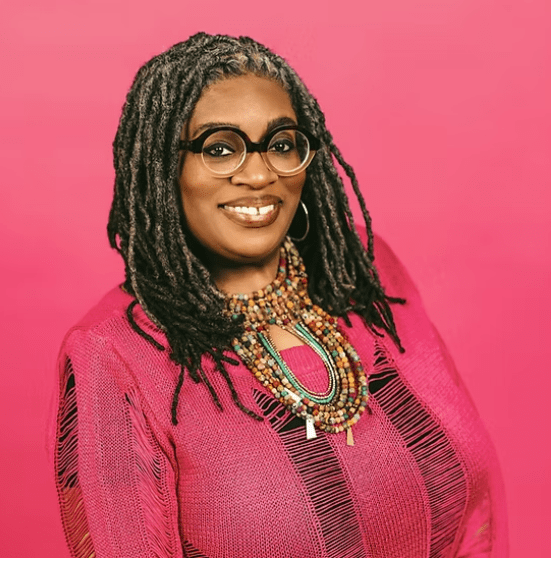
When I sat down with Abena Sankofa Imotep — educator, author, activist, founder of Sankofa Literary and Empowerment Group, and host of Black & Privileged in America — I expected we would talk about literacy and politics. And we did. But what I didn’t expect was how deeply we would explore legacy, protection, truth-telling, and what it means to create boldly in a place that often prefers comfort over confrontation.
What it really means to build without waiting to be invited.
Iowa Nice (But For Who?)
We both grew up here. Born and raised. Iowa girls.
And if you’re from here, you know the phrase: Iowa Nice.
But niceness and equity are not the same thing. You can grow up in a loving Black household, surrounded by cousins and aunties and community, and still understand very clearly how race operates in your state. You can have a beautiful childhood and still be prepared by your parents for what exists beyond your neighborhood block.
That duality — joy and vigilance — shapes many Black Iowans.
Abena’s parents migrated from Jim Crow Mississippi, carrying with them both trauma and discipline. They made sure their children understood the broader racial construct of the country they were growing up in. That awareness didn’t cancel out love. It strengthened it.
You can love Iowa and still interrogate it. Both things can be true.
And usually are.
Literacy as Liberation
When Abena founded Sankofa Literacy Academy, she wasn’t just trying to improve reading scores. She was responding to what she saw — children who were capable of so much more than the metrics assigned to them.
Her academy serves students in grades three through eight. The younger students focus on reading comprehension, ensuring they not only decode words but actually understand what they are reading. The older students lean into creative writing, imagination, and expression.
And the results speak for themselves. In the first year alone, every student showed measurable growth in literacy. But what struck me most wasn’t the data. It was the intentionality.
Abena models her work after the Sankofa principle — looking back to move forward. She draws inspiration from W.E.B. Du Bois’ description of education in Ghana: elders and children gathered in community, learning from one another in a circle. Not domination. Not hierarchy. Exchange.
Because literacy isn’t neutral.
It is identity. It is power. It is voice.
When children learn to comprehend what they are reading, they begin to understand that they can narrate themselves. And when they begin writing creatively, they learn that their imagination is not a luxury — it is a tool.
Sometimes the literature you want doesn’t exist.
So you write it.
Sometimes the canon doesn’t include you.
So you curate your own.
Curating What We Carry Forward
That’s exactly what Abena did with the Sankofa Literary & Empowerment Group’s Essential Reads by Black Authors for 2026.
This isn’t just a book list. It’s a literary blueprint.
The introduction explains that the collection exists to affirm that reading is both remembrance and liberation, and that it is “intentionally Black, intentionally expansive, and intentionally intergenerational.”
That intentionality matters.
The list spans fiction, nonfiction, romance, young adult literature, children’s books, Afrofuturism, and wellness. Because Black life cannot be confined to one genre. We are not one story. We are not one struggle. We are not one aesthetic.
And in the closing, Abena writes, “I believe reading is a form of remembrance and resistance… what we read can inform what we create.”
That line stayed with me.
Because what we read shapes how we think. How we teach. How we love. How we imagine our future.
Creating a reading list without waiting for institutional approval is cultural leadership. It says we will decide what informs our minds. We will decide what stories shape our children. We will not wait to be included.
That is creating without permission.
The Books That Spoke to Me
As I looked through the 2026 list, a few titles immediately rose to the top for me.
Just Our Luck by Denise Williams reminds us that romance and softness belong to us too. Black joy doesn’t have to be radical to be revolutionary.
Good Dirt by Charmaine Wilkerson feels like a meditation on inheritance — what we carry, what we bury, and what we reclaim.
Queenie Is Working On It by Candice Carty-Williams captures the messy, nonlinear process of growth. Healing is not always graceful, and that honesty matters.
Pretty Girl Country by Lakita Wilson speaks directly to navigating identity in predominantly white spaces — a narrative that so many young Black girls in Iowa understand intimately.
And Rosewater by Tade Thompson expands imagination entirely, offering Afrofuturism that refuses small thinking and centers African futurity in a powerful way.
The range of these titles alone — from romance to speculative fiction — affirms that Black literature is not a category. It is a universe.
The Question That Aggravated Me
During our conversation, Abena shared that she once asked a gubernatorial candidate a direct question: “What is your Black strategy?”
Not because Black Iowans are poor. Not because we need charity. But because we are disproportionately impacted by the criminal legal system and economic disparities.
The response avoided the heart of the question.
And that avoidance is telling.
In a state where we make up less than five percent of the population, our concerns are often absorbed into broader narratives. Flattened. Minimized. Overlooked.
But numbers do not determine significance.
Creating without permission also means refusing to let our needs be diluted. It means asking direct questions. It means understanding that representation requires strategy, not slogans.
Legacy or Baton?
When I asked Abena about legacy, she gently shifted the frame. Not legacy, she said. A baton. She described herself jogging slightly ahead, arm extended backward, offering it to whoever is ready to grab hold. That image stayed with me. Legacy can feel heavy, distant, almost museum-like — something polished and placed on a shelf. But a baton is alive. It assumes motion. It requires trust. It demands continuation. It acknowledges that none of us are the finish line; we are part of the relay. What we build is meant to be carried. What we learn is meant to be passed. What we create is meant to move beyond us.
She doesn’t want applause. She wants momentum.
She wants her grandchildren — and all of ours — to know she was here, yes, but more importantly, that she reached back.
Iowa = Home
And here’s what this conversation reminded me about living here, about building here, about loving here: you can claim a place and still challenge it. You can be rooted in Iowa soil and still radical in your imagination. In my town, we teach literacy, we publish books, we curate reading lists, we ask hard political questions, and we light candles before we begin our work. In my town, Black women do not wait to be invited into rooms that were never designed with us in mind — we build new rooms entirely.
We create infrastructure. We create narrative. We create memory. We create future. In my town, we are still reading, still questioning, still imagining, still passing the baton.
And we are doing it without asking for permission.
Stay Connected with Black. Girl. Iowa.
Want to be part of the Black. Girl. Iowa. journey? Here’s how you can stay connected and support the movement:
📱 Follow along on social
Join the conversation and community on Instagram and TikTok:
@blackgirliowa
🛍️ Shop the BlackGirlIowaShop
Explore journaling kits, merch, and creative tools designed to inspire:
Visit my Etsy store
🎧 Tune in to the podcast
Listen wherever you stream — Spotify, Apple Podcasts, Amazon Music, iHeartRadio, Pandora, or YouTube.
Just search Black. Girl. Iowa.
✉️ Subscribe to the blog
Get reflections, updates, and new stories delivered straight to you:
www.blackgirliowa.com

 Black. Girl. Iowa.